Back to Manchuria and Mongolia disorder state problem (満蒙問題)
This page shows the content of Japanese book titled, ‘’The Construction of New Manchuria and Mongolia".
| Web | https://dl.ndl.go.jp/pid/1465372/1/3 |
| Title |
The Construction of New Manchuria and Mongolia: Appendix - Map of Manchuria and Mongolia in the Current Situation 新満蒙の建設 : 附・時局満蒙地図 |
| Author | Matsuo Funakoshi 船越松雄 |
| Published date | 1932 |
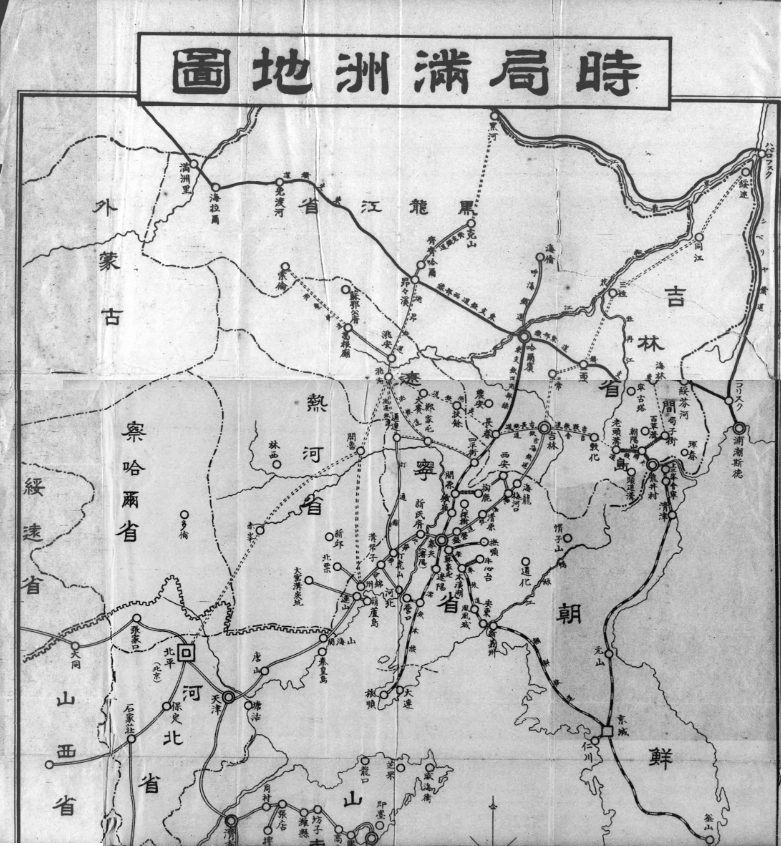
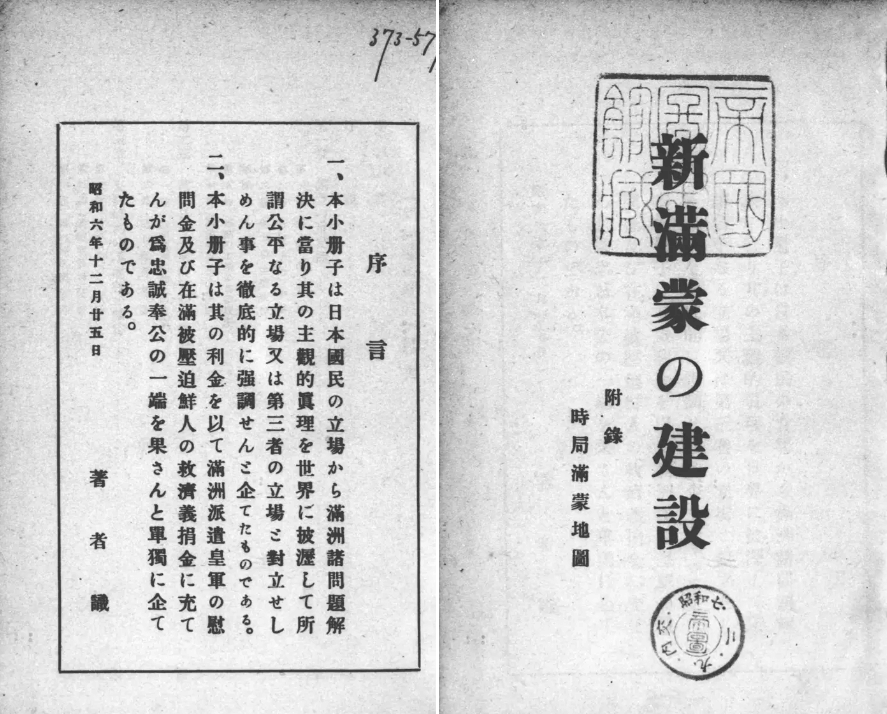
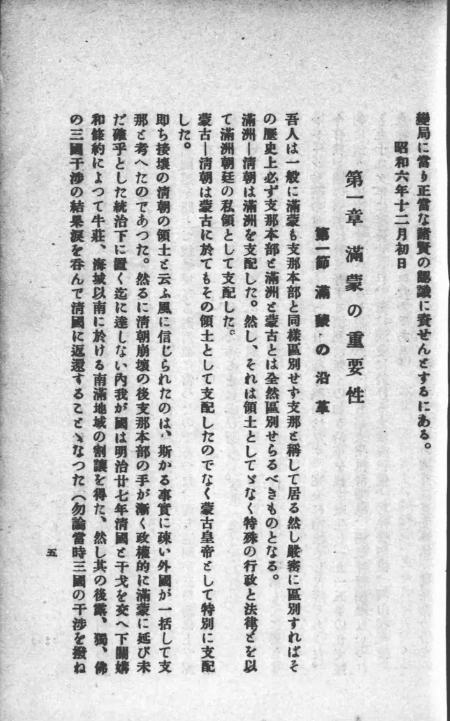
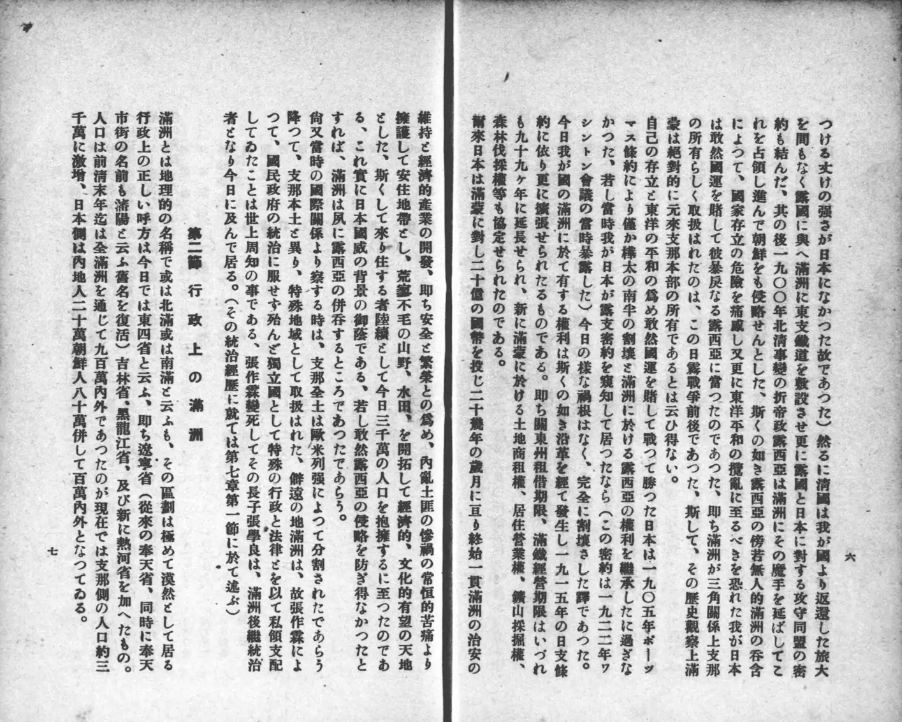
¶ Chapter 1 The importance of Manchuria/Mongolia
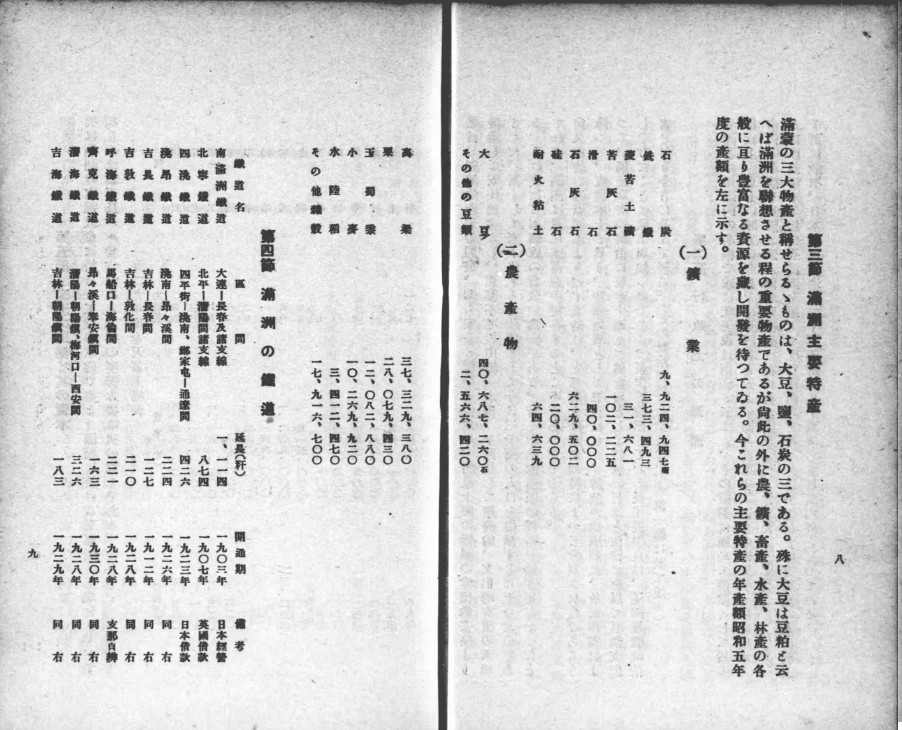
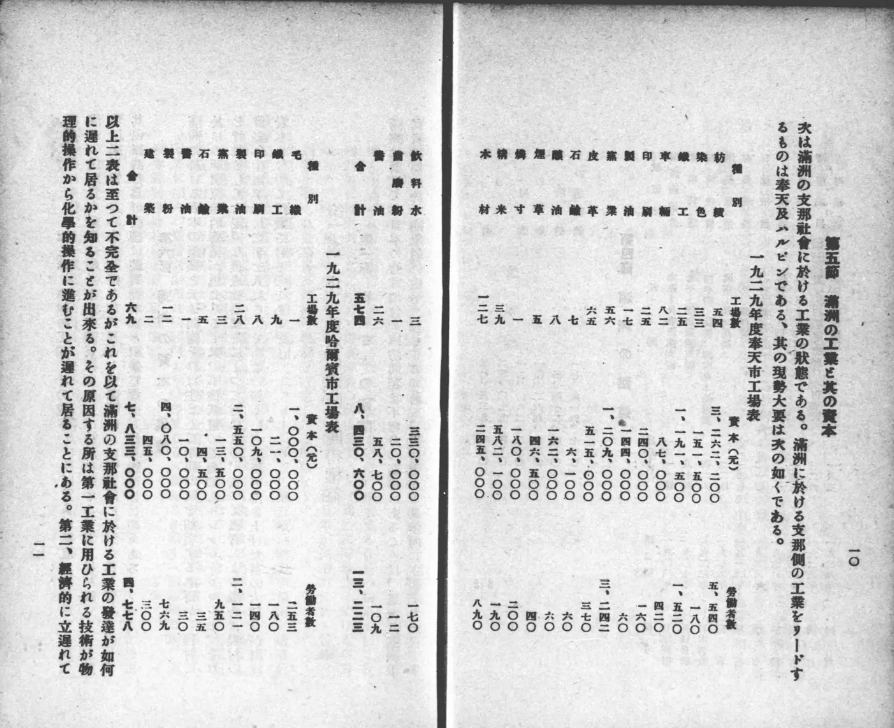
¶ Chapter 2 Japanese rights
(Below) Japanese text followed by English translation
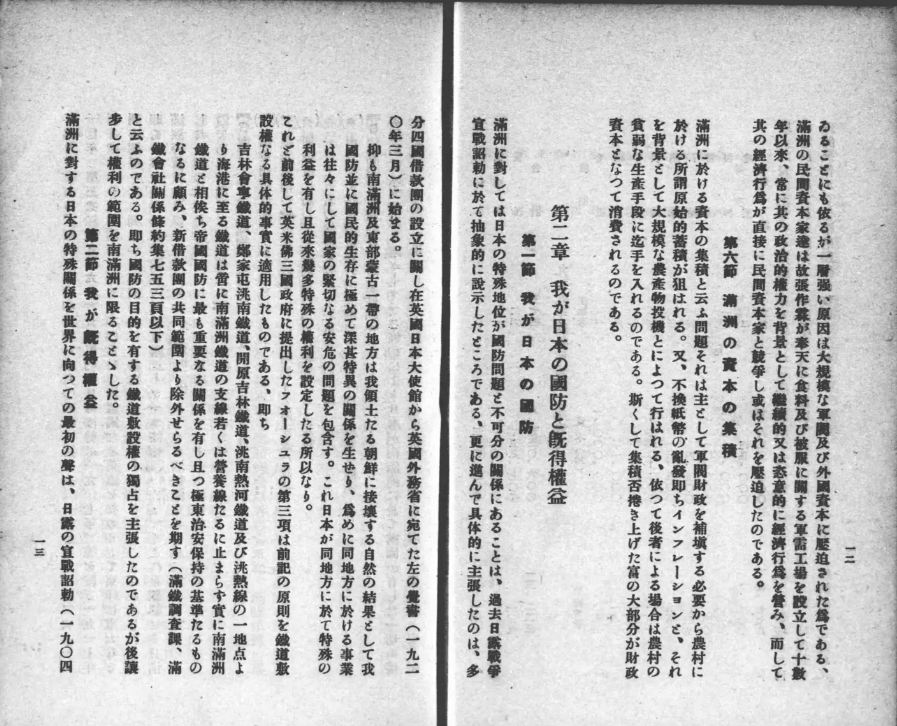 第二章 我が日本の國防と既得権益 第一節我が日本の国防 満洲に対しては、日本の特殊地位が国防間題と不可分の関係にあることは、過去日露戦争、宣戦詔勅(せんせんしょうちょく)に於て抽象的に説示したところである。更に進んで具体的に主張したのは、多分四国借款團の設立に関し、在英国日本大使館から英国外務省に宛てた左の覚書(一九二〇年三月)に始まる。 抑も(そもそも)、南満洲及東部蒙古一帯の地方は我領土たる朝鮮に接壊する自然の結果として我国肪、並に、国民的生存に極めて深甚特異の関係を生ぜり、爲めに同地方に於ける事業は往々にして国家の緊切なる安危の問題を包含す。これ日本が同地方に旅て特殊の利益を有し、旦、従来機多特殊の権利を設定したる所以なり。 これと前後して英米佛三国政府に提出したフォーシュラの第三項は前記の原則を鉄道敷設権なる具体的事實に適用したものである、即ち 吉林會寧鉄道、鄭家屯洮南鐵道、開原吉林鉄道、洮南熱河鉄道及び洮熱線の一地点より、海港に至る鉄道は、啻に南満道の支線、若くは、管養線たるに止まらず實に南満洲鉄道と相俟ち帝国国肪に最も重要なる関係を有し、且つ、極東治安保持の基準たるものなるに顧み、新借款團の共同範園より除外せらるべきことを期す(満鉄調査課、満鉄會社関係条約集 七五三頁以下) と云ふのである。即ち国肪の目的を有する鉄道敷設権の独占を主張したのであるが、後、譲歩して権利の範囲を南満洲に限ることとした。 |
¶ Chapter II: Japan's National Defense and Established Interests
¶ Section I: Japan's National Defense
Regarding Manchuria, Japan's special position is inextricably linked to national defense issues, as abstractly explained in the past Russo-Japanese War and the Imperial Rescript on the Declaration of War. A more concrete assertion likely began with the following memorandum (March 1920) sent from the Japanese Embassy in Britain to the British Foreign Office concerning the establishment of the Four-Nation Loan Syndicate.
Fundamentally, the regions of Southern Manchuria and Eastern Mongolia, bordering our territory of Korea, have naturally given rise to profound and unique relations with our nation's security and the survival of our people. Consequently, undertakings in these regions invariably involve matters of vital national security. This is why Japan possesses special interests in these areas and has established special rights there.
The third clause of the Forsyth proposal submitted to the British, American, and French governments around this time applied the aforementioned principle to the concrete reality of railway construction rights. Specifically:
The Jilin-Haining Railway, the Zhengjiatun-Taonan Railway, the Kaiyuan-Jilin Railway, the Taonan-Rehe Railway, and the railway line extending from a point on the Taonan-Rehe line to a seaport are not merely branch lines of the South Manchuria Railway, or maintenance lines, but are in fact, together with the South Manchuria Railway, of the utmost importance to the Imperial domain and form the basis for maintaining security in the Far East. Therefore, it is intended that they be excluded from the scope of the new loan agreement. (Manchuria Railway Investigation Section, Collection of Treaties Related to the South Manchuria Railway Company, pp. 753 ff.) That is, they asserted the exclusive right to lay railways for national defense purposes, but later conceded to limit the scope of rights to South Manchuria.
(Below) Japanese text followed by English translation
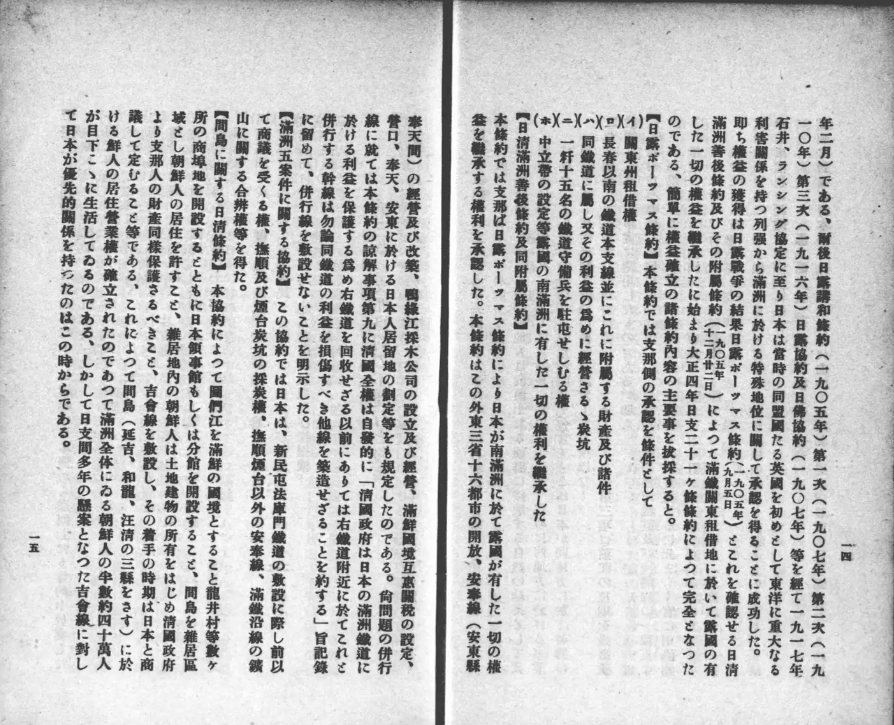 第二節 我が既得権益 満洲に対する日本の特殊関係を世界に向っての最初の聲(こえ)は、日露の宣戦詔勅(一九〇四年二月)である、 爾後(じご)、日露講和條約(一九〇五年)、第一次(一九〇七年)、第二次(一九一〇年)、第三次(一九一六年)日露協約及日佛協約(一九〇七年)等を経て、一九一七年 石井ランシング協定に至り、日本は当時の同盟国たる英国を初めとして東洋に重大なる利害関係を持つ列強から満洲に於ける特殊地位に関して永認を得ることに成功した。 即ち、権益の獲得は日露戦争の結果、日露ポーツマス條約(一九〇五年九月五日)とこれを確認せる日清満洲善後条約、及び、その付属条約(一九〇五年十二月二十二日)によって満鉄関東租借地に於いて露国の有した一切の権益を継承した示したに始まり、大正四年、日支二十一ヶ条条約によって完全となったのである。簡単に権益確率の諸條約内容の主要事を披採すると、 【日露ポーツマス條約】本條約では支那側の承認を条件として (イ)関東州租借権 (ロ)長春以南の鉄道本支線、並に、これに附属する財産及び諸件 (ハ)同鉄道に属し、又、その利益の爲めに経営さる炭鉱 (二)一席 十五名の鉄道守備兵を駐屯せしむる権 (ホ)中立帯の設定等、露国の南満洲に有した一切の権利を継承した 【日清満洲善後條約、及び、同附属條約】 本体約では支那は日露ポーツマス條約により、日本が南満洲に於いて露国が有した一切の権益を継承する権益を承認した。本條約は、この外、東三省十六都市の開放、安奉線(安東縣奉天間)の経営及び改築、鴨緑江採木公司の設立及び経営、満鮮国境互関税の設定、營口、奉天、安東に於ける日本人居留地の劃定(かくてい)等をも規定したのである。尙(なお)、問題の併行線に就ては本條約の諒解事項第九に清国全権は自発的に「清国政府は日本の満洲道に於ける利益を保護する爲め、右鉄道を回収せざる以前にありては、右鉄道附近に於て、これと併行する幹線は勿論同鉄道の利益を損傷すべき他線を、築造せざることを約する」旨記録に留めて、併行線を敷設せないことを明示した。 【満洲五案件に関する協約】 この協約では日本は、新民屯法庫門鉄道の敷設に際し、前以て、商議を受くる権、撫順及び煙台炭抗の採炭権、撫順煙台以外の安泰線、満鉄沿線の鑛山に関する合辦(合弁)権等を得た。 【間島に関する日清條約】 本協約によつて圓們江(えんもんこう:中国と北朝鮮の国境を流れる主要な川)を満鮮の国境とすること龍井村等数ヶ所の商埠地を開設するとともに、日本領事館もしくは分館を開設すること、間島を雑居区域とし、朝鮮人の居住を許すこと、雑居地内の朝鮮人は土地建物の所有をはじめ清国政府より支那人の財産同様保護さるべきこと、吉會線を敷設し、その着手の時期は日本と商議して定むること等である。これによって間島(延古、和龍、江淸の三県をさす)に於ける鮮人の居住營業権が確立されたのであって満洲全体にいる朝鮮人の半数約四十萬人が目下ここに生活してるのである。しかして日支間多年の懸案となつた吉會線に対して日本が優先的開係を持ったのはこの時からである。 |
¶ Section 2: Our Acquired Rights
Japan's first declaration to the world of its special relationship with Manchuria was the Imperial Rescript on the Declaration of War against Russia (February 1904).
Subsequently, through the Treaty of Peace between Japan and Russia (1905), the First (1907) and Second (1910) and the Third (1916) Japan-Russia Agreements, as well as the Japan-France Agreement (1907), culminating in the 1917 Ishii-Lansing Agreement. Through these, Japan succeeded in obtaining permanent recognition of its special status in Manchuria from the great powers with significant interests in the Orient, beginning with its then-ally, Great Britain.
Specifically, the acquisition of rights began with the outcome of the Russo-Japanese War, as demonstrated by Japan's succession to all rights held by Russia in the South Manchuria Railway Kwantung Leased Territory through the Treaty of Portsmouth (September 5, 1905), the Sino-Japanese Treaty for the Settlement of Manchuria (December 22, 1905) confirming this, and its supplementary treaty. This process was completed in 1915 with the Twenty-One Demands Treaty between Japan and China. Briefly outlining the key provisions of the treaties securing these rights:
【Treaty of Portsmouth】
Subject to China's approval, this treaty granted:
(a) The leasehold rights to the Kwantung Province
(b) The main and branch lines of the railway south of Changchun, along with all associated property and facilities
(c) Coal mines belonging to or operated for the benefit of said railways
(d) The right to station fifteen railway guards
(e) Establishment of a neutral zone, etc. Japan succeeded to all rights Russia held in southern Manchuria.
【Sino-Japanese Treaty for the Settlement of Manchuria and its Supplementary Treaty】
The main treaty stipulated that China recognized Japan's right to succeed to all rights and interests Russia held in southern Manchuria under the Japan-Russia Treaty of Portsmouth. Beyond this, the treaty also stipulated the opening of sixteen cities in the Three Eastern Provinces, the operation and reconstruction of the Andong-Fengtian Railway, the establishment and operation of the Yalu River Timber Company, the establishment of reciprocal tariffs along the Manchuria-Korea border, and the demarcation of Japanese settlements in Yingkou, Fengtian, and Andong. Regarding the disputed parallel line, the Ninth Understanding of this treaty explicitly recorded that the Qing plenipotentiary voluntarily pledged: “The Qing government, in order to protect Japan's interests in the Manchurian Railway, promises not to construct any other lines near the said railway that might damage its interests, including parallel main lines, until the said railway is recovered.” thus explicitly prohibiting the construction of parallel lines.
【Agreement Concerning Five Manchurian Matters】
Under this agreement, Japan obtained the right to prior consultation regarding the construction of the Xinmin Dunfukumen Railway, coal mining rights at Fushun and Yantai coal mines, and the right to merge mining rights for mountains along the Antai Line and the South Manchuria Railway line outside Fushun and Yantai.
【Japan-China Treaty Concerning the Shimanto Region】
By this agreement, the Enmon River (the major river forming the border between China and North Korea) shall be established as the border between Manchuria and Korea. Several commercial ports, including Longjing Village, shall be opened, and Japanese consulates or sub-consulates shall be established. designating the Jiaozuo region as a mixed settlement area permitting Korean residence; guaranteeing Koreans within this area protection of property rights, including land and buildings, equivalent to that afforded to Chinese nationals by the Qing government; and constructing the Jihui Railway, with the commencement date to be determined through consultation with Japan. This established the right of Koreans to reside and conduct business in the Jianmen region (referring to the three counties of Yingkou, Hailong, and Jiangqing). Approximately 400,000 Koreans, half of all Koreans in Manchuria, currently live there. Furthermore, Japan gained a privileged position regarding the Jiehui Railway, a long-standing issue between Japan and China, starting from this time.
【Twenty-One Demands Treaty】
Signed May 25, 1915. While Japan has withdrawn certain provisions and renounced others within the treaty, the following points remain valid today:
(1) The lease term for the Kwantung Leased Territory was extended to ninety-nine years. Consequently, the term that should have expired in 1923 was extended until 1997.
(2) The lease terms for the South Manchuria Railway and the Anfeng Line were extended to ninety-nine years. Consequently, the return deadline for the South Manchuria Railway was extended to 2002, and that for the Anfeng Line to 2007. Furthermore, the repurchase rights stipulated in the original treaty were rendered invalid.
(3) Land Lease Rights. Japanese nationals obtained the right to lease land in South Manchuria necessary for constructing various commercial and industrial buildings or for agricultural operations. This right carries a term of thirty years with provisions for unconditional renewal.
(4) The right to freely reside, travel, and engage in various commercial and industrial activities within South Manchuria.
(5) The right to engage in agriculture and related industries through joint ventures with Chinese nationals within Eastern Mongolia.
(6) The right to explore and mine at Niushentai and other mineral deposits in Southern Manchuria.
(7) Revision of all treaties and contracts pertaining to the Chōshū Railway.
¶ Chapter 3 How Han Chinese violated treaties
(Below) Japanese text followed by English translation
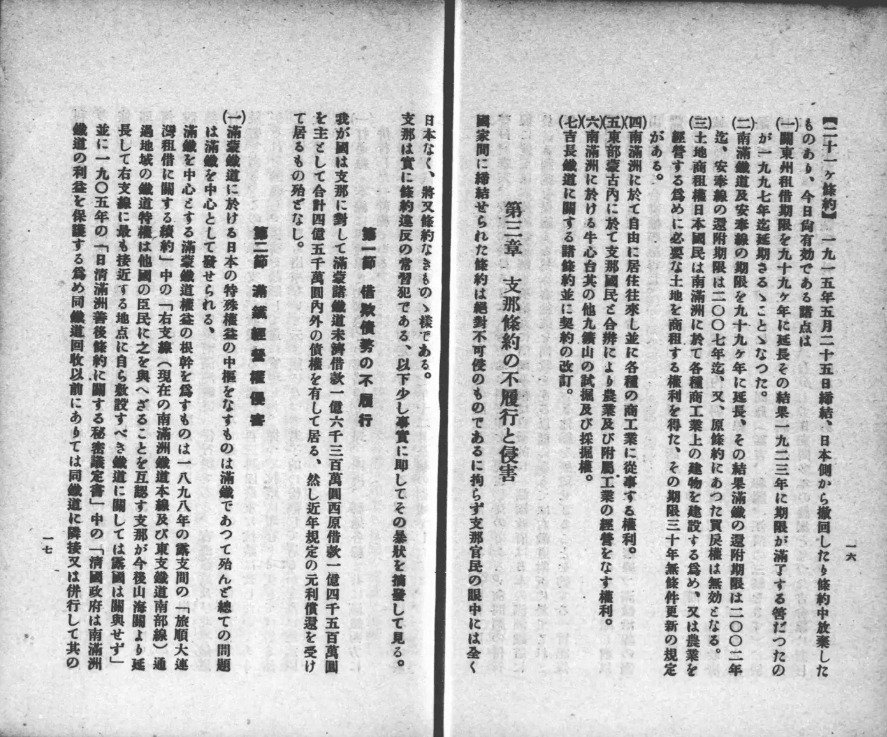 【二十一ヶ條約】:一九一五年五月二十五日締結、日本側から撤回したり條約中、放棄したものあり、今日尙有効である諸点は (一)関東州租借期限を九十九ヶ年に延長、その結果一九二三年に期限が満了する筈だったのがー九九七年迄、延期さるることとなった。 (二)南満洲鉄道及び、安奉線の期限を九十九ケ年に延長。その結果満鉄の還附期限は二〇〇二年迄、安奉線の還附期限は二〇〇七年迄、又、原條約にあった買戻権は無効なる。 (三)土地商租権。日本国民は南満洲に於いて、各種商工業上の建物を建設する爲め、又は、農業を経営する爲めに必要な土地を商粗する権利を得た。その期限三十年無條件更新の規定がある。 (四)南満洲に於いて自由に居住往来し、並に、各種の商工業に従事する権利。 (五)東部蒙古内に於いて、支那国民と合辦(合弁)により農業及び付属工業の経営をなす権利。 (六)南満洲に於ける牛心台、其の他、鑛山の試掘及び採掘権。 (七)吉長鉄道に開する諸條約、並に契約の改訂。
第三章 支那條約の不履行と侵害 国家間に締結せられた條約は絶対不可侵のものであるに拘わらず支那官民の眼中には全く 日本なく、將又(はたまた)條約なきものの様である。 支那は實に條約違反の常習犯である。以下少し事實に即してその暴状を摘発して見る。 第一節 借款責務の不履行 我が国は支那に対して、満蒙諸鉄道未済借款、一億六千三百圓(円)、西原借款一億四千五百萬圓(円)を主として合計四億五千萬圓(円)内外の債権を有して居る。然し近年規定の元利償還を受けて居るもの殆どなし。 第二節 満鉄経営権侵害 (一)満蒙鉄道に於ける日本の特殊権益の中核をなすものは満鉄であって殆ど総じての問題は満鉄を中心として発せられる。 満鉄を中心とする満蒙鉄道権益の根幹を為すものは、一八九八年の露支間の「旅順大連湾租借に関する條約」中の「右支線(現在の南満鉄道本線及び東支鉄道南部線)通過地域の鉄道特権は他国の臣民に之を與へざることを互認す。支那が今後、山海關より延 長して右支線に最も接近する地点に自ら敷設すべき鉄道に関しては露国は關興せず(興味を持たない)」 並に、一九〇五年の「日清満洲善後條約に関する秘密議定書」中の「清国政府は南満洲鉄道の利益を保護する為め同鉄道回収以前にありては同鉄道に隣接又は併行して其の |
Chapter III: Breach and Violation of the China Treaty
Despite treaties concluded between nations being absolutely inviolable, in the eyes of both Chinese officials and the public, Japan is entirely absent, and it is as if no treaty exists.
China is truly a habitual violator of treaties. Below, we shall expose its outrageous conduct based on specific facts.
Section 1: Failure to Fulfill Loan Obligations
Our nation holds claims against China totaling approximately 450 million yen, primarily consisting of outstanding loans for the Manchuria-Mongolia railways amounting to 163 million yen and the Nishihara Loan of 145 million yen. However, in recent years, almost none of the stipulated principal and interest repayments have been received.
Section 2: Infringement of South Manchuria Railway Management Rights
(1) The South Manchuria Railway (Mantetsu) formed the core of Japan's special interests in the Manchuria-Mongolia Railway, and virtually all issues stemmed from it.
The fundamental basis of the Manchuria-Mongolia railway interests centered on the South Manchuria Railway was the mutual recognition in the 1898 Treaty between Russia and China concerning the Lease of the Port of Dalian and the Bay of Dalian that "the railway privileges in the areas traversed by the right branch line (the present-day South Manchuria Railway main line and the southern section of the East China Railway) shall not be granted to subjects of other nations. Should China hereafter extend to the point nearest the aforementioned branch line, Russia shall not interfere."
and the 1905 “Secret Protocol to the Sino-Japanese Treaty for the Settlement of Manchuria,” which states: “The Chinese government undertakes not to construct any main or branch lines adjacent to or parallel with the South Manchuria Railway, which might prejudice its interests, prior to the recovery of said railway.” The former is a treaty between Russia and China, Russia ceded this to Japan under the Treaty of Portsmouth, and China acknowledged this cession in the Sino-Japanese Treaty of Manchuria, thus making it explicitly a treaty between Japan and China.
That is, Japan can decisively exclude and refuse the realization of any other railway within Manchuria that would in any way impede the Manchurian Railway's profits, regardless of location or distance, and regardless of whether the railway's builder is China or any other foreign power, except for those whose construction Japan has approved.
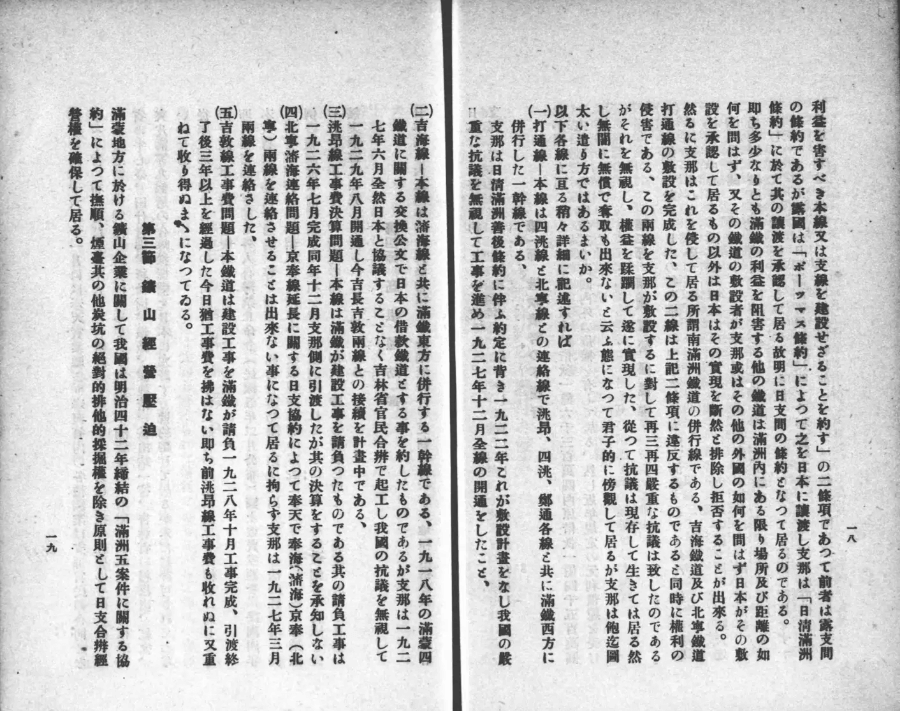 利益を害すべき本線又は支線を建設せざることを約す」の二條項であって前者は露支問の條約であるが、露国は「ポーツマス條約」によって之を日本に譲渡し、支那は「日清満洲條約」に於て、其の譲渡を承認して居る故、明に日支間の條約となって居るのである。 即ち、多少なりとも、満鉄の利金を阻害する他の鉄道は、満洲内にある限り、場所及び距離の如何を問はず、又その鉄道の敷設者が支那、或はその他の外国の如何を間はず、日本がその敷設を承認して居るもの以外は、日本はその實現を断然と排除し拒否することが出来る。 然るに支那はこれを使して侵してる所謂(いわゆる)南満洲鉄道の併行線である、吉海鉄道及び北寧鉄道打通線の敷設を完成した。この二線は上記二條項に違反するものであると同時に、権利の使害である。この南線を支那が敷設するに対して再三再四、厳重な抗議は致したのである、それを無視し、権益を蹂躙して遂にに實現した。従って抗議は現存して生きては居る然し無闇に無償で奪取も出来ないと云う態になって君子的に傍観して居るが、支那は飽迄(あくまで)圓太い(えんぶとい)遣り方ではあるまいか。以下各線に亘る稀々詳細に記述すれば、 (一)打通線 本線は四洮線と北寧線との連絡線で洮昻、四洮、鄭通各線と共に満鉄西方に併行した一幹線である。支那は日清満洲善後條約に伴ふ約定に背き、一九二二年これが敷設計書をなし、我国の厳重な抗議を無視して工事を進め、一九二七年十二月全線の開通をしたこと。 (二)吉海線 本線は瀋海線と共に満鉄東方に併行する一幹線である。一九一八年の満蒙四鉄道に関する交換公文で日本の借款鉄道とする事を約したものであるが、支那は一九二七年六月、全然日本と協議するここなく吉林省官民合辦(合弁)で起工し我国の抗議を無視して、一九二九年八月開通し、今吉長吉敦雨線との接續(接続)を計晝(けいかく)中である。 (三)洮昻線工事費決済問題 本線は満鉄が難設工事を講負ったものである其の請負工事は、一九二六年七月完成、同年十二月支那側に引渡したが、其の決算をすることを承知しない。 (四)北寧瀋海連絡問題 京奉線延長に関する日支協約によって、奉天で奉海(瀋海)京奉(線)兩線(両線)を連絡させることは出来ない事になって居るに拘らず、支那は一九二七年三月兩線(両線)を連絡さした。 (五)吉敦線工事費問題 本鉄道は難設工事を満鉄が請負、一九二八年十月工事完成、引渡終了後、三年以上を経過した今日猶工事費を拂はない(払わない)。即ち洮昻線工事費も收れぬ(おさめれぬ)に又重ねて、收り得ぬままになっている。
第三節 鑛山經營壓迫 満蒙地方に於ける鑛山企業にして、我国は明治四十二年締結の「満洲五案件に関する協約」によって撫順、煙臺(煙台)共の他炭坑の絶対的排他的探堀権を除き、原則として日支合辦(合弁)権を確保して居る。 |
Nevertheless, China has exploited this to encroach upon Japan's interests by completing the construction of the so-called parallel lines to the South Manchuria Railway: the Jihai Railway and the Beining Railway extension line. These two lines violate the aforementioned two articles and constitute an abuse of rights. Japan has repeatedly lodged stern protests against China's construction of this southern line. China ignored these protests, trampled upon Japan's rights and interests, and ultimately realized the project. Therefore, while our protests remain valid and alive, we find ourselves in a position where we cannot simply seize them without compensation. We are thus observing from the sidelines in a gentlemanly manner, but is China not being utterly shameless in its approach? Detailed descriptions of each line follow:
(1) The Datsun Line: This main line served as a connecting route between the Sitao Line and the Beining Line, forming a single trunk line running parallel to the Manchurian Railway's western section alongside the Tao-Ang, Sitao, and Zhengtong lines. China violated the agreements accompanying the Sino-Japanese Treaty of Manchuria, prepared construction plans for this line in 1922, proceeded with construction despite Japan's stern protests, and opened the entire line in December 1927.
(2) Jilin-Haicheng Line: This main line, along with the Shenyang-Haicheng Line, forms a major trunk line running parallel to the Manchurian Railway on its eastern side. Although the 1918 exchange of notes concerning the four Manchuria-Mongolia railways stipulated it would be a Japanese loan railway, China commenced construction in June 1927 as a Jilin Province government-private joint venture without any consultation with Japan. Ignoring Japan's protests, it opened in August 1929 and is currently planning a connection with the Jilin-Changchun-Jilin-Tumen-Yulin Line.
(3) Settlement of Construction Costs for the Tao-Ang Line: This main line involved difficult construction work undertaken by the South Manchuria Railway. The contracted work was completed in July 1926 and handed over to the Chinese side in December of the same year, but China refuses to settle the accounts.
(4) Beining-Shenhai Connection Issue: Despite the Japan-China Agreement concerning the extension of the Jingfeng Line stipulating that the Fengtian-Shenhai and Jingfeng lines cannot be connected at Fengtian, China connected the two lines in March 1927.
(5) Construction Costs for the Jilin-Dunhuang Line: The South Manchuria Railway undertook the difficult construction work for this railway. Construction was completed and handed over in October 1928. Yet, more than three years later, the costs remain unpaid. That is, not only have the costs for the Tao-Ang Line construction not been collected, but these costs also remain unpaid.
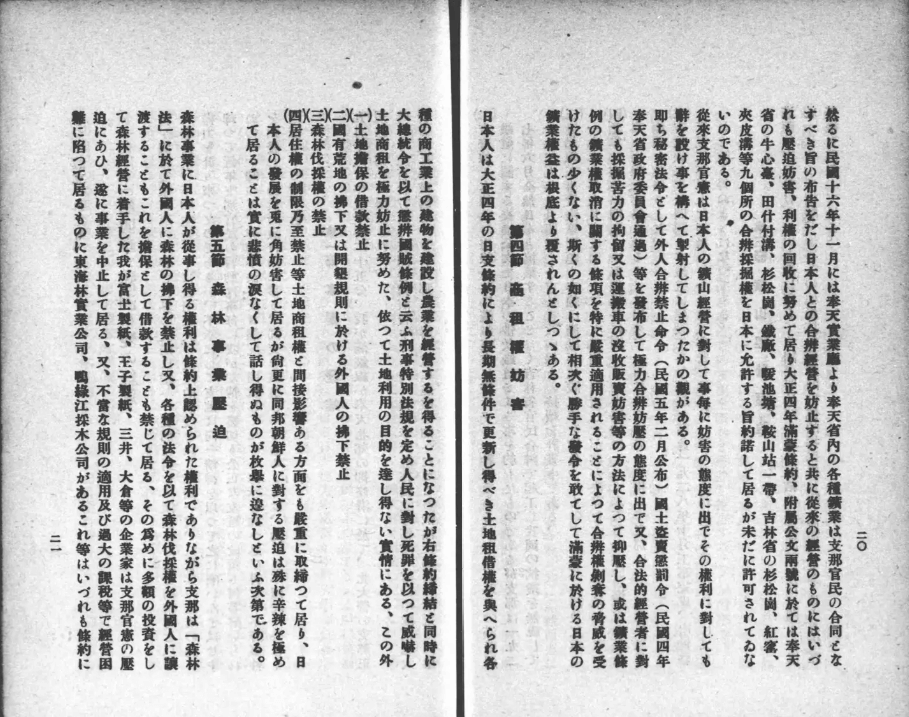 然るに民国十六年十一月には奉天實業廳(ちょう)より奉天省内の各種鑛業は支那官民の合同となすべき旨の布告をだし、日本人との合辦(合弁)経営を妨止すると共に、従来の経営のものには、いづれも、壓迫妨害、利権の回収に努めて居り、大正四年満鉄條約、附属公文兩號(両号)に於ては奉天省の牛心臺(台)、田什付溝、杉松崗、鉄廠、暖池塘、鞍山站一帯、吉林省の杉松崗、夾皮溝等、九個所の合辦(合弁)採掘権を日本に允許(いんきょ)する旨、約諾して居るが、未だに許可されていないのである。 従来、支那官憲は日本人の鑛山経営に対して事毎に妨害の態度に出て、その権利に対しても辭を設け、事を構えてして掣射(せいしゃ:束縛する)しまったかの觀がある。 即ち、秘密法令として外人合辦禁止命令(民国五年二月公布)国土盗實懲罰令(民国四年奉天省政府委員會通貨)等を発布して、極力合辦防壓の態度に出て、又、合法的経営者に対しても、採掘苦力の拘留、又は、運搬車の没収販売妨害等の方法によって抑壓し、或いは、鑛業條例の鑛業権取消に関する條項を特に厳重適用されることによって合辦権剥奪の脅威を受けたもの少なくない。斯くの如くにして、相次ぐ勝手な発令を敢えてして、満鉄に於ける日本の鑛業権液は根底よりお覆されんとしつつある。
第四節 商租権妨害 日本人は大正四年の日支條約により長期無條件で更新し得べき主地租借を興へられ各種の商工業上の建物を建設し、農業を経営するを得ることになったが、右條約締結と同時に大總統令を以て、懲辦国賊條例と云ふ刑事特別法規を定め、人民に対し死罪を以って威嚇し土地商租を極力防止に努めた。依って、土地利用の目的を達し得ない實情にある。この他、 (一) 土地確保の借款禁止 (二) 国有荒地の払い下げ、又は、開墾規則に於ける外国人の払い下げ禁止 (三) 森林伐採権の禁止 (四)居住権の制限、及び、至禁止等、土地商租権と間接影響ある方面をも厳重に取り締まっており、日本人の発展を兎に角妨害して居るが、尚更に、同邦朝鮮人に対する壓迫は殊に辛辣を極めて居ることは、實に悲憤の涙なくして話し得ぬものが枚挙に遑なしといふ次第である。
第五節 森林事業壓迫 森林事業に日本人が従事し得る権利は條約上認められた権利でありながら、支那は「森林法」に於て、外国人に森林の払い下げを禁止し、又、各種の法令を以て森林伐採権を外国人に譲渡することも、これを擔保(担保)として借款することも禁じて居る、その為に多額の投査をして森林経管に着手したが、我が富士製紙、王子製紙、三井、大倉等の企業家は支那官憲の壓迫にあひ、遂に事業を中止して居る。又、不当な規則の適用、及び、過大の課税等で経営困難に陥って居るものに東海林實業公司、鴨緑江採木公司がある。これ等はいづれも條約によって設立されたものである。 |
Section 3: Oppressive Mine Management Practices
Regarding mining enterprises in the Manchuria-Mongolia region, Japan secured joint Sino-Japanese operation rights in principle under the “Agreement Concerning the Five Manchurian Matters” concluded in 1909, with the exception of absolute exclusive exploration rights for the Fushun and Yantai coal mines and other coal deposits.
However, in November 1927, the Fengtian Provincial Industrial Bureau issued a proclamation stating that all mining operations within Fengtian Province must be jointly operated by Chinese government and private entities. This not only prohibited joint ventures with Japanese partners but also subjected existing operations to relentless pressure, obstruction, and efforts to reclaim rights and interests. Furthermore, the 1915 South Manchuria Railway Treaty and (both documents) granted Japan joint mining rights for nine locations: Niuxindao, Tianshifugou, Shansonggang, Tiechang, Nantichang, the Anshan Station area in Fengtian Province, and Shansonggang and Jiapigou in Jilin Province. Yet, these permits have still not been granted.
Traditionally, Chinese authorities have consistently obstructed Japanese mining operations, finding excuses to restrict their rights and deliberately creating obstacles to hinder them.
Specifically, they issued secret decrees such as the Prohibition of Foreign Joint Ventures (promulgated February 1916) and the Punishment for Land Theft Ordinance (issued by the Fengtian Provincial Government Committee in 1915), adopting an attitude of extreme suppression against joint ventures. Furthermore, even against legitimate operators, they suppressed them by methods such as detaining mining laborers, or confiscating and selling transport vehicles to obstruct operations. Furthermore, many faced the threat of having their joint venture rights revoked through the particularly strict application of provisions in the Mining Regulations concerning the cancellation of mining rights. In this manner, through successive arbitrary decrees, the foundation of Japanese mining rights within the South Manchuria Railway is being fundamentally undermined.
Section 4: Interference with Commercial Lease Rights
Under the Japan-China Treaty of 1915, Japanese nationals were granted long-term, unconditional land leases, enabling them to construct various commercial and industrial buildings and engage in agricultural operations. However, simultaneously with the treaty's conclusion, a special criminal ordinance called the Punishment of Traitors Ordinance was enacted by Presidential Decree, threatening the people with capital punishment and vigorously attempting to prevent land leasing. Consequently, the actual purpose of land utilization cannot be achieved. Additionally,
(1) Prohibition of Loans for Land Acquisition
(2) Prohibition of Foreigners Acquiring State-Owned Uncultivated Land or Acquiring Land under Reclamation Regulations
(3) Prohibition of Forest Logging Rights
(4) Restrictions on residence rights, prohibitions, etc. These measures severely regulate areas indirectly affecting land leasing rights, obstructing Japanese development at every turn. Moreover, the oppression inflicted upon Koreans within the same nation is particularly harsh and extreme. The countless instances of such oppression are truly beyond description without tears of grief and indignation.
Section 5: Oppression in Forestry Operations
Although the right for Japanese to engage in forestry operations is recognized under treaty, China prohibits the sale of forests to foreigners under its “Forest Law.” Furthermore, various statutes forbid the transfer of logging rights to foreigners or using such rights as collateral for loans. Consequently, despite substantial investments to commence forest management, Japanese companies like Fuji Paper, Oji Paper, Mitsui, and Okura have faced oppression from Chinese authorities and ultimately ceased operations. Furthermore, companies like the Tokai Forestry Company and the Yalu River Timber Company have fallen into operational difficulties due to the application of unreasonable regulations and excessive taxation. These companies were all established under treaty provisions.
Back to Manchuria and Mongolia disorder state problem (満蒙問題)